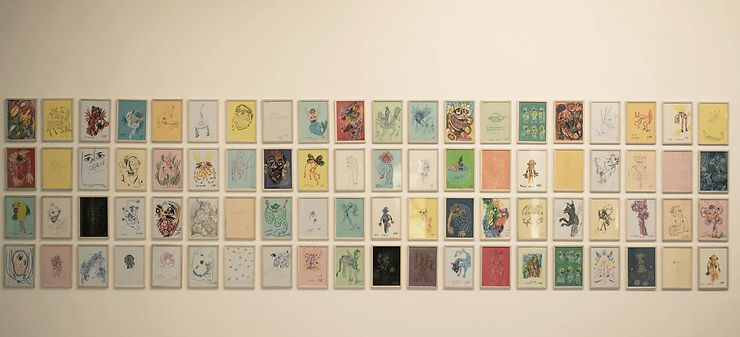
WHY, 2024
Not every exhibition begins with an answer. Some begin with a trembling, honest question.
WHY was born at the end of a residency , a period of sustained, almost violent creative output where the question was never what to make, but something far more primal: why does it keep coming? Why does the hand reach for the pencil before the mind has formed a thought? Why does the body insist on making marks even when it is exhausted, uncertain, overwhelmed?
The works in WHY were not planned. They were received.
That is the only word for it. Inspiration, for me, is not a quiet visitor , it arrives like a current running through the body, and the work is simply how much of it I can hold before it has to come out through the wrist, the line, the colour. This exhibition was a record of that process pushed to its limit. Drawing, painting, animation , each medium a different way of asking the same question, each piece evidence that something passed through me and left a mark.
There is gratitude in these works. There is also exhaustion, confusion, and the particular beauty of not knowing where you are going but moving anyway. Personal struggles are not hidden here , they are the material. Uncertainty is not the absence of meaning; it is meaning in its most alive, unresolved form.
WHY was the culmination of a residency but it felt more like a reckoning. An attempt to understand not what I make, but what making does to me , and what it asks of me in return.
I still don't have a clean answer. But I made 2024's most honest attempt at one.






Maa, 2024
Three thousand drawings. One world.
Maa did not begin as an artwork. It began as a listening , to the earth, to memory, to the deep and wordless intelligence of trees. What emerged was something that could not be contained in a single frame or a single moment: an odyssey, hand-drawn line by line, into the realm of Gaia herself.
The word Maa carries weight across languages and cultures. Mother. Earth. Origin. The title was never just a name , it was an invocation.
At the heart of Maa is a single idea that opens into infinity: all islands are trees. Rooted below the surface, reaching upward, surrounded by vastness, shaped by wind and time and the memory of what came before. Mauritius is an island. A tree. A living thing with roots we cannot always see but which hold everything above the ground. This animation was an attempt to draw those roots , all of them, all at once, across three thousand pages.
Ancient mysticism moves through the work like sap. The images draw from collective memory , not one person's history but the accumulated dreaming of people, land, and story across generations. There is ritual in the repetition of mark-making at this scale. To draw three thousand times is not a task; it is a practice, a devotion, a form of prayer.
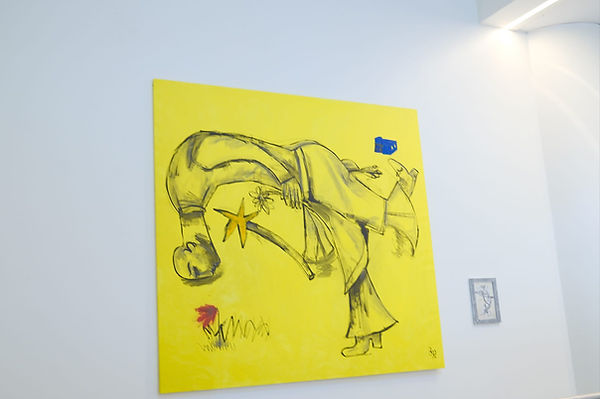
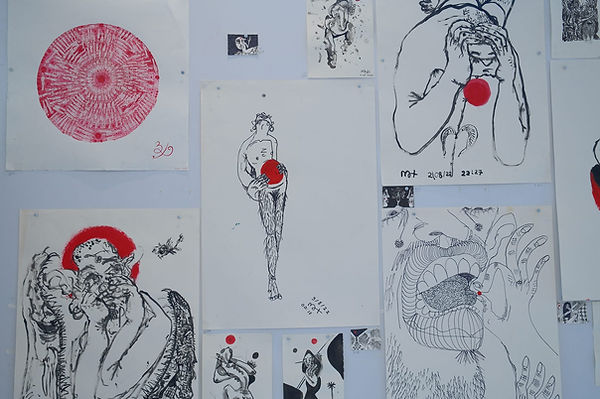
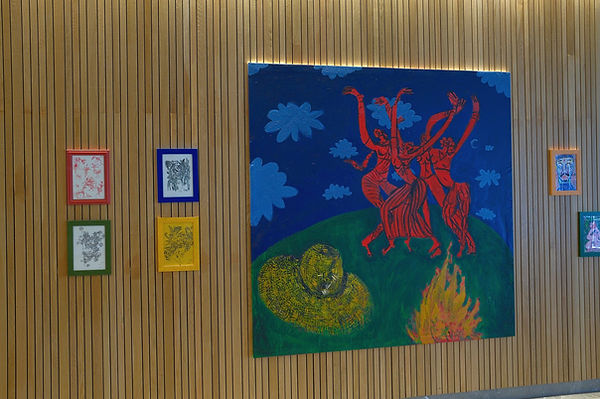
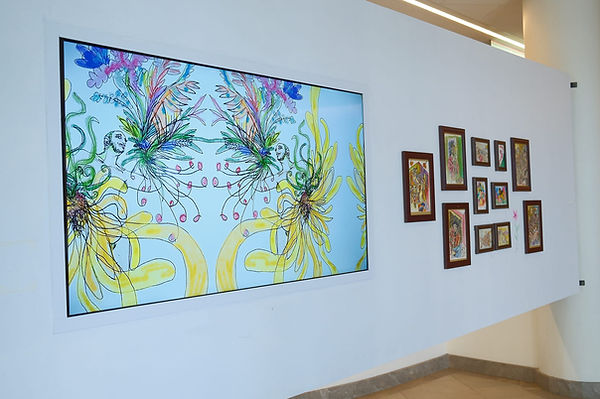
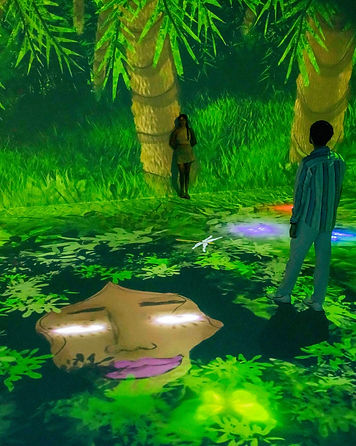
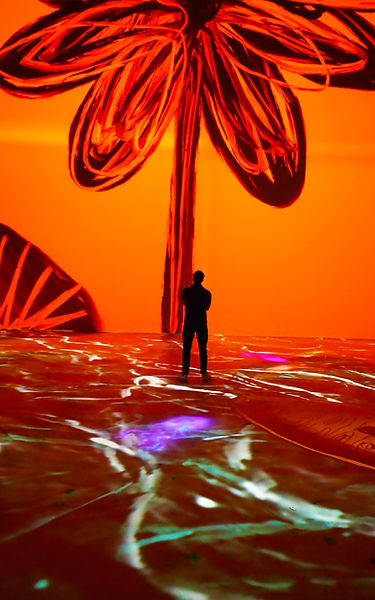
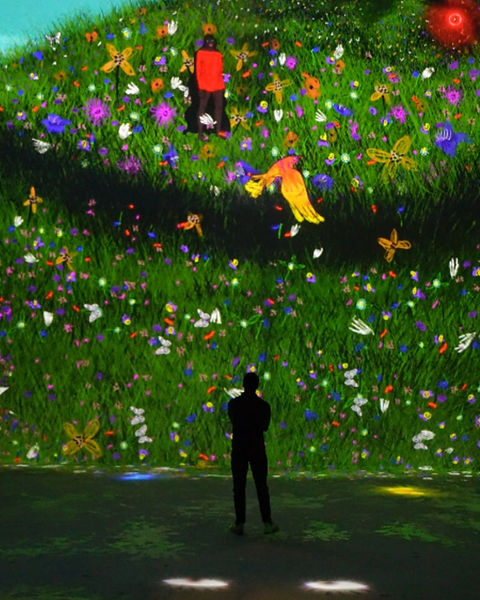
The installation itself was conceived as a total environment. Four screens rose across the walls, surrounding the visitor on every side with moving image , the forest, the roots, the mythic creatures of Gaia breathing and shifting in the peripheral vision as much as the direct gaze. Beneath your feet, a fifth screen transformed the floor into living earth, into water, into the very ground of the world the animation inhabited. To stand inside Maa was to stand inside the drawing itself , no longer observer but element, held within the work the way a seed is held within soil.
Brought to life through the editing of Frédéric Antoinette and the sound world built by Emmanuel Travailleur and Asheel Tymun, the space became fully charged , image above, below, and all around, sound moving through the body like roots move through ground.
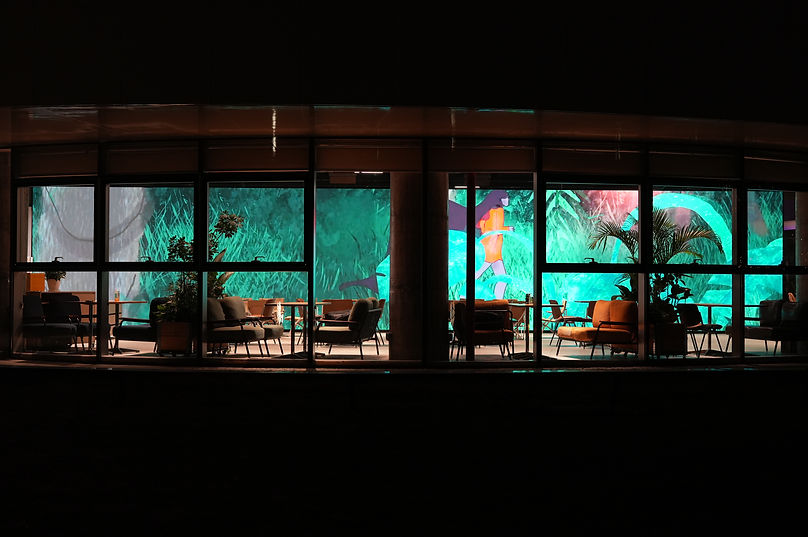
Maa is a living work. Over the years it has been presented in different forms across Mauritius and beyond , adapted to each space it has entered, growing with every new context. In Mauritius it grew taller, the screens heightened to fill the full architecture of the room. In China it expanded outward, widened to embrace a broader, more monumental scale. Each iteration has been its own encounter , the same soul, a different body, a different conversation with the land and the people receiving it.
You did not watch Maa. You entered it. You stood on it. It grew around you.
As you can see in the pictures below, the work shifts with every space , yet always remains unmistakably itself.





Ma, 2024
Before the three thousand drawings. Before the immersive walls and the floor that became earth. There was Ma.
Fourteen paintings. Three hundred drawings. One minute of animation. And a question that would take years to fully answer.
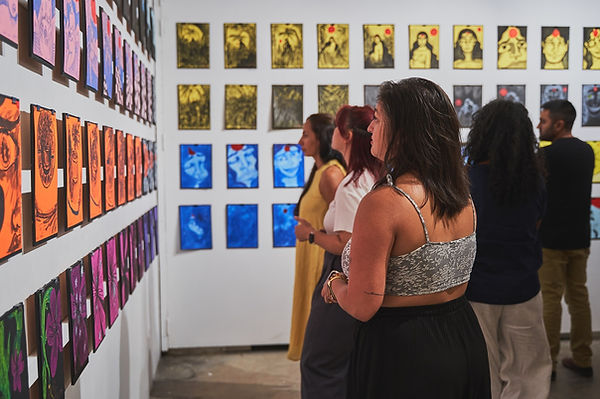
Ma was born in February , made during long nights and solitary hours in a studio heavy with work, with feeling, with the particular silence that comes when you stop performing and start telling the truth. It was shown at The Basement, Caudan Arts Centre, on the 8th of March , International Women's Day , not as a coincidence but as a declaration.
The women in Ma are not observed. They are inhabited. Catherine, Jenny, Sherazad, Eve , each one a figure drawn from the interior, from the multiple worlds living inside a single person. They are painted with the kind of colour that does not decorate but magnetises, chosen not by the mind but by something older and more instinctive. Their eyes are the constant , gazes that follow, that wait, that search the soul of whoever stands before them. They are united not by story but by longing. By the need to love and be loved without condition.
Ma was an exploration of maternal love , not as sentiment but as force. The melancholy of motherhood. The desire to give life. The image of a mother and child as the deepest, most ancient thread connecting a human being to the world. For an artist who had spent years learning to hide himself, learning to become someone else in order to survive, to paint this was an act of profound vulnerability.
The exhibition came to exist because of Chloé Mayotte, who saw the paintings of women and felt the invisible thread connecting them , and understood, before the artist had fully articulated it, that they belonged together as a single body of work.
Ma is the word for mother across so many languages. It is also the beginning of Maa , the world, the earth, the great living system that holds all of us. The first exhibition was intimate, interior, human. The second would expand outward into myth and forest and the memory of the earth itself.
But it began here. With these women. With their waiting eyes. With the quiet, radical act of painting what you carry inside and offering it to the room without apology.
Ma was part one. The seed. The root before the tree.




Max Anish Gowriah, 2022
There is a painting that has never been fully seen. Not even by the person who made it.
For his 30th birthday, Max Anish Gowriah embarked on one of the most quietly radical acts of his practice: a monumental work made of 30 individual pieces, each one painted alone, in isolation from the others, without knowledge of what the whole would become. Like life itself, the complete picture remained unknown to him as he made it. He was simultaneously the artist and the audience, surprising himself at every turn.
The pieces fit together like a puzzle. But the puzzle is unfinished. And that incompleteness is not a flaw. It is the point.
Each panel is a fragment of time, a distillation of a daily painting practice stretched across a milestone year. To look at any single piece is to hold a moment. To imagine them assembled is to begin to understand what it means to be thirty years inside a life, accumulating experiences that do not always seem connected until, suddenly, from the right distance, they are.
The puzzle as metaphor runs deep here. Life resists being seen whole while you are living it. You work on one piece at a time. You do not know how it fits. You do not know what the finished image looks like or whether it will ever be finished at all. You simply make the next mark, place the next piece, and trust that meaning is assembling itself somewhere beyond your line of sight.
In Mauritius, no space could be found tall enough or wide enough to show all thirty pieces together. The painting existed in full only in theory, only in potential. The artist who made it has never stood back far enough to see it complete. There is something profound in that. A work of art created entirely on faith, its wholeness deferred, its final image still waiting for the right room, the right light, the right moment.
Thirty years. Thirty pieces. One life still being assembled.
London show, 2021
Some exhibitions happen in galleries. This one happened in a home.
A friend opened his space in London and did something rare: he did not hang the work on walls, he built the walls around the work. Murals rose across the surfaces, across the ceiling, the entire interior transforming itself into a single breathing environment shaped by and for the paintings. The space did not contain the exhibition. It became it.
The work shown was some of the most personal Max Anish Gowriah had made to that point. It circled a theme that had no easy name: the discomfort of living inside a body that does not feel like yours. The strangeness of inhabiting a self that the world assigns to you before you have had any say in the matter. Gender not as identity politics but as something far more intimate and physical, a daily friction between what is felt from the inside and what is seen from the outside.
These were not paintings made to explain or to argue. They were made to confess. To put into image what language struggles to hold: the experience of looking in a mirror and meeting a stranger. Of moving through a world built for a version of you that you have never fully recognised.
The ceiling above your head carried it. The walls around you carried it. There was nowhere in that room that was not inside the feeling.
It was the kind of exhibition that could only have existed once, in that exact place, held by that exact generosity. A home made briefly into a body. A body made briefly into art.


I AM, 2020
There is a particular kind of courage in showing up as yourself , all of yourself , in a room full of strangers.
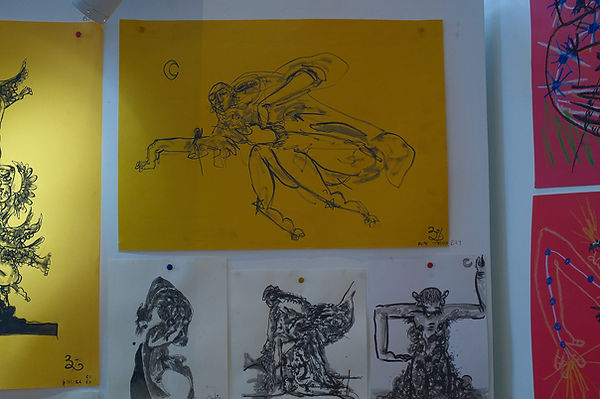
I AM, my first solo exhibition at Imaaya Gallery, was exactly that. 176 works across the walls , 100 drawings, 76 paintings , each one a fragment of an ongoing conversation I have been having with myself for as long as I can remember. A conversation between Anish, the boy who grew up in Flacq, and Max, the person he needed to become in order to breathe.
Max was born when I was 16. Not out of confusion, but out of necessity. Mauritius, for all its beauty, did not yet have space for everything I was. So I made space. I created a character fluid enough to carry me , through Florence, through fashion, through the canvas, through the line.
The work in I AM is not a manifesto. It is something quieter and more honest than that: a record of moods, of mornings, of moments of anger and tenderness and searching. The drawings come fast, almost compulsively, because I believe that quantity is the path to quality , that the hand teaches the eye, that repetition is its own kind of discipline. The influence of Schiele is there in the angular, searching line. Klimt, Blake, Bacon, Giacometti , they live in my repertoire not as imitation but as apprenticeship. You learn to see by studying those who saw clearly.
What I am working toward , what this exhibition marks the beginning of , is the moment when Anish and Max no longer need to be two separate people. When the self I protected behind a name can simply stand in the light and say: I am this. All of it.
I AM was that first step into the light.